1. What is the False Vacuum Decay?
“The possibility that we are living in a false vacuum has never been a cheering one to contemplate.”— Sidney Coleman
Before we explore what false vacuum decay is, we need to understand:
- What a vacuum is?
- What is a true vacuum and false vacuum?
2. Vacuum
- The vacuum discussed here is not empty space. It's an area with the lowest energy configurations possible.
- In a vacuum, the fields like higgs or electromagnetic fields will be at very low configurations.
- In simpler terms, imagine this as a place where the energy is weakest.
3. True and False Vacuum
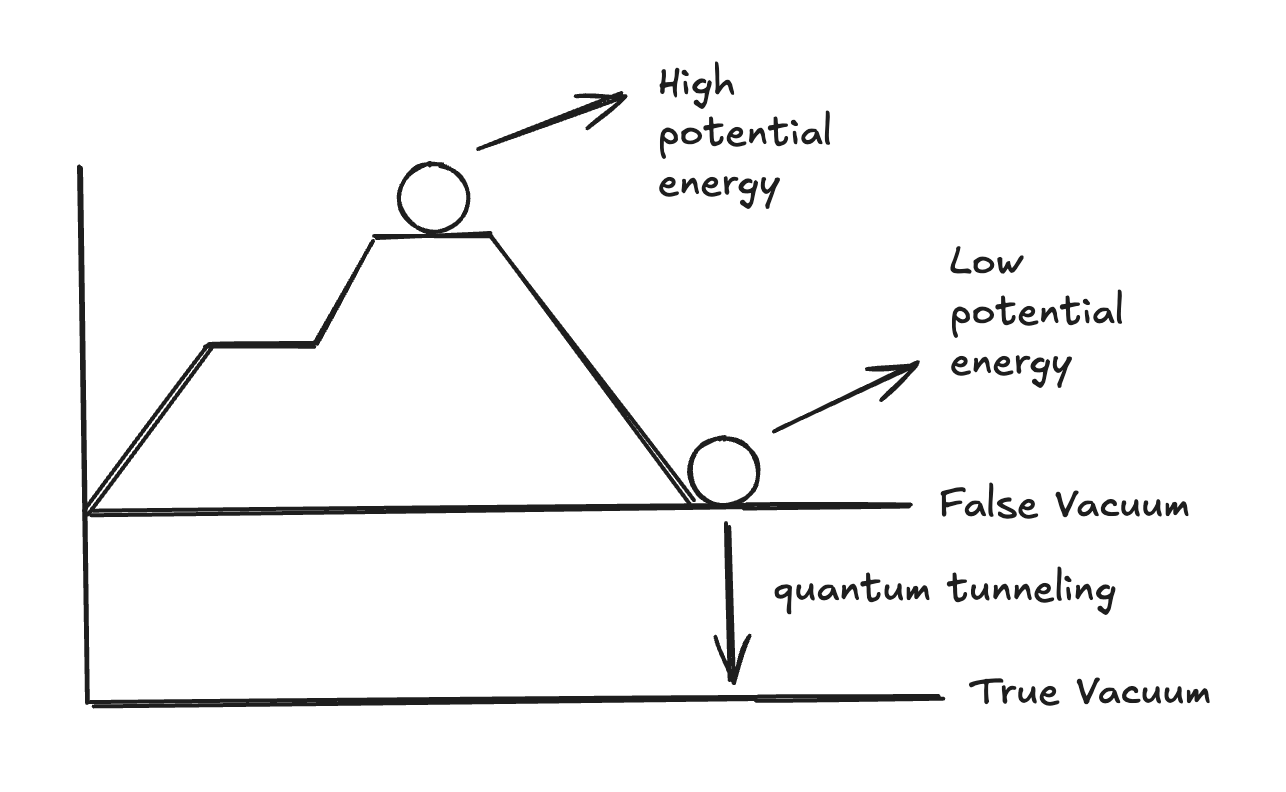
- A true vacuum is a place where the energy is actually low.
- There is a speculation that what we now know as a vacuum is a false vacuum.
- If that's the case then due to quantum tunneling, a small region of space can go from this false vacuum to true vacuum.
- A bubble of true vacuum forms. The bubble can then expand.
- The fields can have different properties inside the bubble and these fields affect how the universe works. So inside the bubble, the universe can work differently.
4. What Could Happen?
1
A bubble forms — A tiny region of true vacuum is formed.
2
The bubble expands — The bubble can then expand at the speed of light.
3
Fundamental fields change — The values of quantum fields inside the bubble could differ from those outside it.
4
Matter could become unstable — Depending on the new vacuum, atoms and other familiar structures might no longer be able to exist.
5
There may be no warning — A bubble expanding at nearly light speed could reach us before any information about its arrival could.
6